Last updated October 2026
If you are starting to look at early learning in Napier, Montessori is likely to come up, perhaps because a friend’s child goes to one or you have seen the wooden materials online. The name gets used loosely, though, and it is not always clear what makes a Montessori preschool different from a standard daycare or kindergarten. This guide explains how the approach works, what a typical day looks like, the honest pros and cons, and what to look for when you visit a centre in Napier.
★View the Best Daycares in Napier→What Montessori Actually Is
Montessori is an approach to learning developed by Dr Maria Montessori, an Italian doctor who opened her first Casa dei Bambini, or Children’s House, in Rome in 1907. Her idea was that young children learn best by doing, choosing their own work from a carefully prepared room, and repeating it until they have mastered it. The adult’s job is to observe, show the child how to use each material, and then step back.
The national body, Montessori Aotearoa New Zealand, describes it as a child-centred approach that nurtures independence and individuality. In practice that shows up in three things you will notice straight away in any genuine Montessori preschool: mixed ages in one room, low open shelves of specific materials, and a long, uninterrupted stretch of work time.
What a Day Looks Like
The work cycle
The heart of the day is the work cycle, usually a block of two to three hours in the morning, and often another in the afternoon. Children choose an activity from the shelves, take a mat to mark out their space, work for as long as they are absorbed, then return the material so another child can use it. Teachers move around the room giving short individual lessons rather than leading the whole group. Most centres open and close the session with a short mat time for songs, news or karakia.
Materials that teach one idea at a time
Montessori materials are designed so that each one isolates a single concept. Sandpaper letters let a child trace the shape of a letter while saying its sound. The movable alphabet lets them build words before their hands are ready to write. Golden bead materials make place value something a four-year-old can hold. Many materials are self-correcting, so a child can see their own mistake without an adult pointing it out.
Practical life
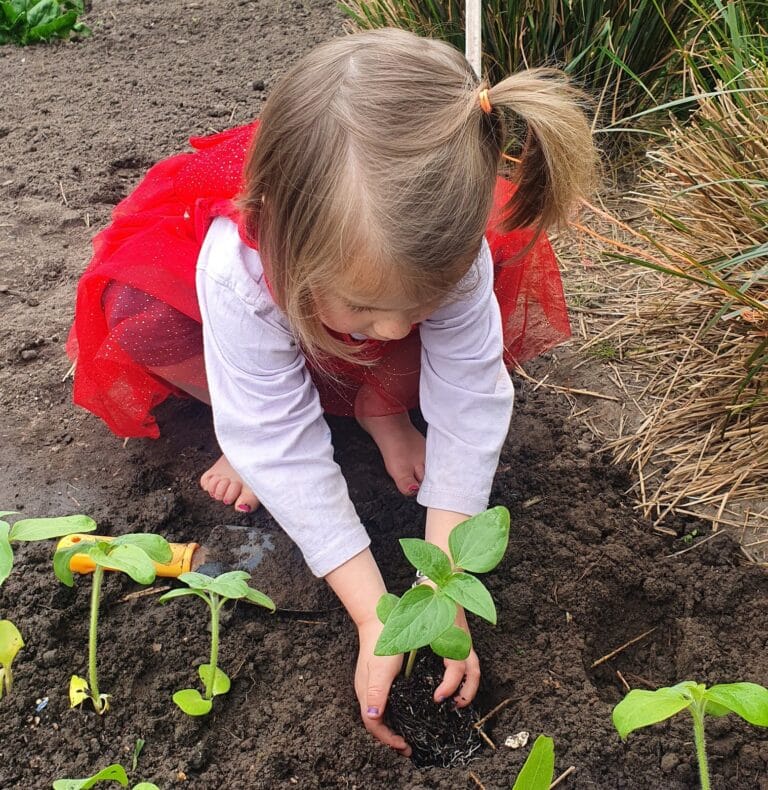
A large part of the room is given to everyday tasks: pouring, spooning, sweeping, buttoning, preparing food and caring for plants. These look simple, but they build concentration, coordination and the sense that a child can look after themselves and their space. Outdoors, gardening, growing seedlings and caring for the environment often play the same role.
Montessori Compared With a Standard Daycare
Every licensed early learning service in New Zealand works within Te Whāriki, the national early childhood curriculum, so the difference is in the method rather than the goals. A quick comparison:
Who chooses the activity
- Montessori preschool
- The child, from prepared shelves
- Typical play-based centre
- Mix of free play and teacher-planned group activities
Age grouping
- Montessori preschool
- Mixed, usually around 3 to 6 together
- Typical play-based centre
- Often split into baby, toddler and preschool rooms
Learning materials
- Montessori preschool
- Specific Montessori sets, each with one purpose
- Typical play-based centre
- Open-ended toys, art and construction
Structure of the day
- Montessori preschool
- Long uninterrupted work cycles
- Typical play-based centre
- More frequent transitions between activities
Literacy and maths
- Montessori preschool
- Introduced through hands-on materials when the child is ready
- Typical play-based centre
- Woven through play, stories and everyday routines
Neither is better for every child. A child who loves deep focus and order often thrives in a Montessori room, while a child who lives for imaginary games and big group play may be happier somewhere more open-ended.
Questions Parents Often Ask
Why don’t Montessori teachers say “good job”?
Many Montessori teachers avoid general praise and instead describe what the child did: “You poured all of that without spilling.” The aim is for children to feel satisfaction in the work itself rather than working for an adult’s approval. It can feel unusual at first, but the encouragement is still there, it is just more specific.
Is there pretend play?
Classic Montessori classrooms put more weight on real tasks than on make-believe, so you may see a real child-sized kitchen rather than a toy one. Children still play imaginatively outdoors and with each other, and centres differ in how strictly they follow this, so it is worth asking.
What are the common criticisms?
Some parents find the approach too structured, or worry about less group play. The other fair point is that how closely a centre follows the method varies a lot, so the quality of teacher training and the completeness of the materials matter more than the word on the sign.
How young can my child start?
Many Montessori preschools take children from around two and a half to three, once they are ready to work with small materials and spend time away from a parent. Some also keep children until their sixth birthday, which can suit a child who needs a little longer before school.
What to Check When You Visit a Montessori Preschool in Napier
- Ask what Montessori training the teachers hold, and who leads each curriculum area.
- Watch the work cycle. Children should be choosing, concentrating and putting things away, with teachers giving one-to-one lessons.
- Look at the shelves for full sets of materials for practical life, sensorial, maths and literacy.
- Ask how progress is recorded and shared with you, and how goals are set for your child.
- Read the centre’s latest report on the Education Review Office website before you go.
- Check how 20 Hours ECE is applied for three, four and five year olds, and what the session options are.
- Ask about settling in. Several short transition visits with a parent make the first weeks far easier.
Napier families also tend to weigh up location carefully. A centre on the way to work in Napier South, Taradale or Greenmeadows can save a lot of time, and it is worth checking parking and drop-off at the times you would actually use it.
Where Montessori 3-6 Fits
Montessori 3-6 is a trilingual Montessori preschool on the corner of Georges Drive and Chambers Street in Napier South, led by founder Vicky Lumsden, who is both primary and early childhood trained. It takes children from around two and a half until the day before their sixth birthday, keeps its roll to 30, and runs three-hour Montessori work cycles with indoor and outdoor flow, alongside daily te reo Māori and Spanish. Their own page on why they chose Montessori sets out how the approach works in their rooms, and families can book a tour and see the enrolment options to watch a work cycle in person before deciding.